 LegalFoundation & Legal CoursesBasics of Cyber ForensicsStart here. Evidence handling, imaging, hashing, chain of custody and your first analysis.
Digital Evidence Management
Digital evidence management is the system of records, storage and controls that lets a laboratory say exactly where an exhibit has been, who touched it and why, at any moment from seizure to disposal.
Evidence, law and practice8 evidence types7 tools3 coursesReviewed 2 November 2026
What it is and why it matters
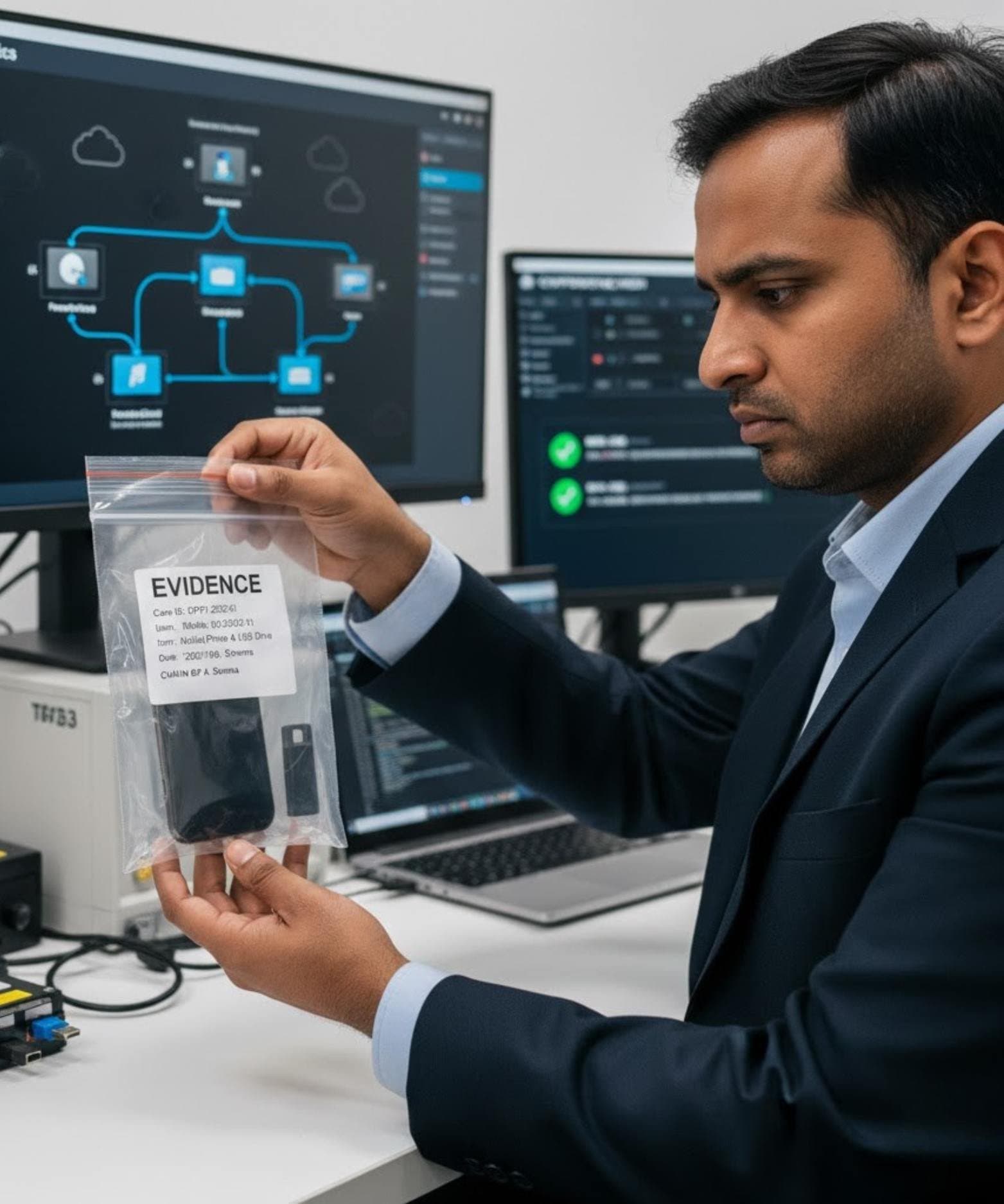
An examiner's findings are only as good as the account of how the exhibit reached the bench. If a phone sat unlabelled in a drawer for a week, or a hard drive image was copied to a shared folder anyone could open, the other side does not need to attack the analysis. They attack the handling. Evidence management exists to close that door.
The discipline covers physical items and the data taken from them. A seized laptop is tracked by its exhibit number, its seal and its location. The image made from it is tracked by its hash, the storage it sits on and the people who can read it. Both trails have to join up, so that an image produced in court can be traced back to a specific device, a specific acquisition and a specific examiner.
Good management is mostly paperwork done at the right time. Intake forms, custody logs, storage registers, access records, retention schedules and disposal certificates are dull, but they are what a court or a client's lawyer will ask to see first. Laboratories that run under a quality system such as ISO/IEC 17025:2017 build these records into daily routine.
Types of digital evidence
- Physical Exhibits
Computers, phones, drives, memory cards, routers and DVRs, each with a unique exhibit number, seal and description tied to the seizure record.
- Forensic Images and Extractions
Bit-for-bit images, logical and file system extractions, memory captures and cloud exports, identified by hash and stored as working copies separate from the sealed original.
- Chain of Custody Records
The dated, signed log of every transfer, examination and return of an item, which is the backbone of admissibility.
- Acquisition Records
Write-blocker details, tool versions, start and end times, hash values and any errors, kept with the image they describe.
- Examination Notes and Case Files
Contemporaneous notes, screenshots, tool reports and the final report, held together so that another examiner could reconstruct the work.
- Access and Audit Logs
Who logged into evidence storage, who copied an image and when, drawn from the evidence server and the laboratory's management system.
- Authority Documents
The warrant, consent form, court order, engagement letter or corporate authorisation that permitted seizure and examination.
- Return and Disposal Certificates
Records showing that an item went back to its owner or was destroyed, with the date, the method and the approving signature.
Devices and data sources
- Computers and storage devices seized under a warrant or under section 185 of the Bharatiya Nagarik Suraksha Sanhita, 2023
- Phones, SIM cards and memory cards handed over by complainants or seized from suspects
- Corporate devices surrendered by employees under policy or consent
- CCTV DVRs, NVRs and exported video files from premises
- Cloud exports and provider responses received on media or by secure transfer
- Memory captures and triage outputs from live systems
- Images and extractions received from other laboratories or agencies for re-examination
- Paper records and printouts that accompany electronic exhibits
- Damaged devices sent for hardware recovery, which must be tracked through the repair as well
How an examination runs
The order matters. Each step protects the one after it.
- 01Intake
Receive the item with its authority document, check the seal against the seizure record, photograph it, assign the exhibit number and record its condition and any accessories. Refuse or flag anything that arrives without paperwork.
- 02Label and Seal
Attach a durable label with the exhibit number and seal the item in tamper-evident packaging. Record the seal number. Every later opening and resealing is logged.
- 03Store Securely
Place the item in a locked, access-controlled store with conditions suited to electronics. Keep phones in signal-blocking storage where the examination plan calls for it. Record the location in the register.
- 04Acquire and Register the Copy
When the exhibit is examined, log it out, image or extract it, hash the result and register the image with its hash, the storage path and the examiner's name. Return the original to the store and log it back in.
- 05Control Access to Data
Keep images on evidence storage with per-case access, not on shared drives. Record who copied or exported anything and why. Working copies are made from the verified image, never from the original.
- 06Track Every Movement
Record every hand-over, court production and inter-agency transfer in the chain of custody log with date, time, purpose and signatures. Use the same exhibit number across organisations where possible.
- 07Retain and Dispose
Apply the retention period set by law, court order or client agreement. When it ends, return the item or sanitise and destroy it and the images, and record the disposal with a certificate.
Tools used in this discipline
Independent profiles: what each tool does, where it stops and what you need to know before using it.
- Storage and hardwareCurrentHardware Write BlockersVarious manufacturers
A hardware write blocker sits between an evidence drive and the examiner's computer and refuses every write command. It is the first device a new examiner should understand.
- Storage and hardwareCurrentForensic DuplicatorsVarious manufacturers
A forensic duplicator is a standalone imaging device. It copies a source drive to a destination drive or image file, hashes the result and verifies it, without a computer in between.
- Computer forensicsCurrentExterro FTK ImagerExterro
FTK Imager is the free tool most learners meet first. It makes forensic images of drives, folders and memory, verifies them with hashes and lets an examiner preview evidence before committing to a full acquisition.
- Computer forensicsCurrentOpenText Forensic (EnCase)OpenText
EnCase Forensic, one of the oldest names in computer forensics, is now called OpenText Forensic (EnCase). OpenText says it is the same product, renamed to fit its cybersecurity portfolio.
- Computer forensicsCurrentMagnet AxiomMagnet Forensics
Axiom is Magnet Forensics' main examination platform. It takes images and extractions from computers, phones, cloud accounts and vehicles into a single case and presents the artefacts side by side.
- Mobile forensicsCurrentCellebrite ReaderCellebrite
Cellebrite Reader is a free, portable viewer for UFDR files, the report format produced by Physical Analyzer and Inseyets. It lets people outside the lab review the evidence without a licence.
- Computer forensicsCurrentAutopsySleuth Kit Labs
Autopsy is a free, open source examination platform that puts a graphical interface and ingest modules on top of The Sleuth Kit. For a student it is the first tool that shows a whole case from image to report at no cost.
Terminology
- Exhibit
- A single item of evidence identified by a unique number in the case. An image taken from an exhibit is a derived exhibit with its own record.
- Chain of Custody
- The continuous, documented account of who had an item, when, where and for what purpose, from the moment it was collected.
- Tamper-Evident Seal
- Packaging or a numbered seal that shows clearly if it has been opened, so that any break can be explained in the log.
- Evidence Register
- The master list of exhibits in the laboratory, their locations and their status, kept on paper, in a spreadsheet or in a laboratory information management system.
- Working Copy
- A copy of the verified forensic image used for analysis, so that the original image and the original device are never altered.
- Retention Schedule
- The rule that says how long each class of exhibit and data is kept and what triggers its return or destruction.
- Access Control
- The technical and procedural limits on who can enter the evidence store or open case data, with a record of each access.
- Laboratory Information Management System
- Software that tracks cases, exhibits, custody, tasks and reports in one place and produces the audit trail a court may ask for.
- Disposal Certificate
- The signed record that an exhibit or data set was returned, sanitised or destroyed, with the date and the method.
Challenges and limits
What makes it hard
- Volume of exhibits and images outgrows storage and the register, so items get lost in backlog unless intake is strict
- Items pass through several organisations with different forms and numbering, creating gaps in the chain
- Phones left powered in storage can receive remote wipe commands or lose their unlocked state, so storage conditions matter
- Data copies multiply during analysis and sharing, and every uncontrolled copy is a confidentiality and integrity risk
- Retention periods are often undefined, leaving laboratories holding exhibits and personal data for years without a rule
- Paper logs are easy to backfill or lose, and electronic systems are only as good as the discipline of the people using them
Keeping the evidence intact
- One exhibit number, one label, one register entry, applied at intake before anything else happens
- Seal numbers recorded at every opening and resealing, with the reason for opening
- Hash of every image registered at acquisition and re-verified before analysis and before production
- Access to evidence storage and case data logged automatically and reviewed
- Originals never leave the store except by logged check-out for a stated purpose
Standards and legal considerations
- ISO/IEC 27037:2012
Guidelines for identification, collection, acquisition and preservation of digital evidence, including the roles of first responders and specialists and the documentation each must keep.
Read the guide - ISO/IEC 17025:2017
General requirements for the competence of testing and calibration laboratories. Evidence handling, records and traceability are part of its management system requirements.
- SWGDE Best Practices
Documents such as Best Practices for Digital Evidence Collection and Position on Timely Preservation via Digital Acquisition set practical expectations for handling and records.
Read the guide - Bharatiya Nagarik Suraksha Sanhita, 2023
Section 105 requires search and seizure, including the preparation and signing of the seizure list, to be recorded by audio-video electronic means and forwarded to the Magistrate without delay. That recording becomes part of the custody story.
Read the guide - Digital Evidence Lifecycle
How collection, preservation, examination, presentation and disposal connect, and where custody records sit in each stage.
Read the guide
In practice
- A Seal Number That Did Not Match
A hard drive arrives at the laboratory with a seal number different from the one on the seizure memo. The intake officer photographs both, refuses to open the package and records the discrepancy. The investigating officer later explains a resealing at the police station that was never logged, and the explanation goes into the case file before any examination starts.
- Three Agencies, One Phone
A phone seized in one state is examined in a second laboratory and produced in a court in a third. Because every transfer used the same exhibit number and a signed hand-over form, the examiner can read out the full custody history in the witness box without consulting anyone else.
- An Image on the Wrong Share
An audit finds a forensic image copied to a departmental share so a colleague could help with a search. The copy is hashed, found identical, deleted and the event recorded with a corrective action. The laboratory adds a technical block on copying images outside the evidence server.
This page is educational material, not legal advice. Laws and standards change, commence on different dates and are interpreted differently across jurisdictions. Always read the official text linked on this page and take advice from a qualified professional for a real matter.
Learn it at DFRTI
Free pages explain. These courses teach it on real devices with a mentor.
LegalFoundation & Legal CoursesBasics of Cyber ForensicsStart here. Evidence handling, imaging, hashing, chain of custody and your first analysis. LegalFoundation & Legal CoursesLegal & Court ProceduresIndian law on electronic evidence: BSA Section 63, BNSS search and seizure and the IT Act.
 LegalFoundation & Legal CoursesForensic Report WritingWrite clear forensic reports that answer the questions asked and survive cross-examination.
Related reading
- What NIST SP 800-88 Rev. 2 ChangedNIST published the final NIST SP 800-88 Rev. 2 in September 2025 and withdrew the 2014 revision. The new edition drops the media-by-media technique tables and asks organisations to run a sanitization programme instead. Here is what moved, what stayed and what it means for disposing of IT assets in India.Standards update
- DPDP Rules, 2025 and Their Phased CommencementThe Digital Personal Data Protection Rules, 2025 were notified by MeitY in November 2025 under section 40 of the Digital Personal Data Protection Act, 2023. They come into force in three stages over eighteen months. This update sets out what we verified in the Gazette text, what each stage brings and what a forensic laboratory or training institute should start doing now.Standards update
- Hash Verification in Digital EvidenceA hash value is the one number that lets a court trust that the copy examined is the copy seized. This tutorial covers which algorithms to use and why, when to hash, how hash sets work, how to verify an image against its source and how to write hashes into the chain of custody and the report, with a worked synthetic example.Technical tutorial
Standards for this area
- DPDP Act 2023India's first general data protection law. It binds anyone who decides how digital personal data is processed, and it reaches forensic laboratories because evidence copies and case files are full of other people's data.Act
- DPDP Rules 2025The Rules fill in the detail the Act left to the Government: what a notice must say, what counts as reasonable security, how a breach is reported, how long data is kept and how the Board works. They come into force in three stages over eighteen months.Rules
- BSA 2023The evidence law in force since 1 July 2024. It treats electronic records as documents, lets copies stand as primary evidence and requires a certificate with hash values whenever an electronic record is tendered under section 63.Act
- Evidence LifecycleDigital evidence passes through twelve stages between the moment someone realises a device matters and the day its copies are destroyed. Each stage protects the next, and every weak link is found by the other side.Guide
- GDPRThe General Data Protection Regulation is the European Union's data protection law. It follows the data, so a laboratory, training institute or incident response team in India is caught the moment it handles information about people in the EU for an EU client.Regulation
- UK GDPR and DPA 2018The United Kingdom kept the GDPR after leaving the EU as the UK GDPR, supplemented by the Data Protection Act 2018. The Data (Use and Access) Act 2025 is now changing both in stages, so dates matter more than usual on this page.Act
- CCPA / CPRACalifornia's privacy law applies to for-profit businesses that meet revenue or volume thresholds, and it reaches their vendors by contract. It is a state law, enforced by the Attorney General and a dedicated agency, and it is not the law of the rest of the United States.Act
- ISO/IEC 27037:2012ISO/IEC 27037:2012 is the international standard for the first hours of digital evidence handling, from spotting a device to keeping it unchanged. This page explains what it asks for and how a laboratory in India puts it to work.Standard
- ISO/IEC 27041:2015ISO/IEC 27041:2015 answers the question every court eventually asks: how do you know your method works? It is the assurance standard of the ISO/IEC digital investigation family.Standard
- ISO/IEC 27042:2015ISO/IEC 27042:2015 picks up where ISO/IEC 27037:2012 stops. It covers what an examiner does with a preserved copy, how to keep analysis separate from opinion and what a report must let a reviewer check.Standard
- ISO/IEC 27043:2015ISO/IEC 27043:2015 is the map of the whole investigation, from preparing before anything goes wrong to closing the case. The other ISO/IEC forensic standards are its chapters in detail.Standard
- NIST SP 800-88 Rev. 2NIST SP 800-88 Rev. 2 is the reference most organisations name when they say a drive was securely erased. This page sets out what the final September 2025 text contains and how a forensic laboratory, which both erases media and examines erased media, should use it.Standard
- SWGDE Best PracticesSWGDE publishes the free, practical documents that most digital forensic procedures are quietly built on. This page explains how the library is organised, which documents matter for each kind of work and how they relate to the OSAC Registry.Best practice
Questions people ask
Is a chain of custody form enough?
It is the minimum. The form records transfers, but a court may also ask about storage conditions, who had access, how the image was made and whether the seal was intact. Evidence management is the whole set of records that answer those questions.
What happens if a gap is found in the chain?
It does not automatically make the evidence inadmissible, but it weakens it and must be explained honestly. The person who held the item during the gap gives an account, and the laboratory records the gap and the explanation rather than hiding it.
Can images be stored on ordinary cloud storage?
Only with controls equal to the evidence store: encryption, per-case access, logging and a known jurisdiction. Many laboratories keep images on their own servers for that reason. Whatever is chosen, the location is recorded and the hash is checked after every move.
How long must evidence be kept?
As long as the law, the court or the engagement requires, and that varies by matter. The point is to have a written retention rule for each case and a recorded disposal when it ends, not to keep everything forever.
Further reading
More in Evidence, law and practice
Go deeper with DFRTI
Free pages explain the ground. Structured courses, lab work and a mentor take you from knowing about it to doing it on a case.