 LegalFoundation & Legal CoursesLegal & Court ProceduresIndian law on electronic evidence: BSA Section 63, BNSS search and seizure and the IT Act.
Bharatiya Sakshya Adhiniyam, 2023
The evidence law in force since 1 July 2024. It treats electronic records as documents, lets copies stand as primary evidence and requires a certificate with hash values whenever an electronic record is tendered under section 63.
ActParliament of India2023In forceReviewed 2 November 2026

The Bharatiya Sakshya Adhiniyam, 2023 is Act 47 of 2023. It received assent on 25 December 2023 and, under section 1(3), was brought into force on 1 July 2024 by notification S.O. 849(E) of the Ministry of Home Affairs dated 23 February 2024. It replaces the Indian Evidence Act, 1872 and applies to all judicial proceedings before any court, including courts-martial, but not to affidavits or to proceedings before an arbitrator.
Most of the Adhiniyam restates the 1872 Act in modern numbering. The digital provisions are the part that is genuinely new, and they respond to two decades of argument about certificates, originals and copies. The drafters put electronic records inside the definition of document, said when a digital copy is primary evidence, kept the computer-output route to admissibility and attached a Schedule that tells a party and an expert exactly what to certify.
What follows is an educational guide for examiners and students. Court practice on these sections is still forming and the reader should check current decisions before relying on any reading here.
Definitions and Primary Evidence
D
- Document, Section 2(1)(d)
- Any matter expressed, described or otherwise recorded on any substance by letters, figures, marks or other means, and it includes electronic and digital records. Illustration (vi) spells it out: an electronic record on emails, server logs, documents on computers, laptops or smartphones, messages, websites, locational evidence and voice mail messages stored on digital devices are documents.
E
- Evidence, Section 2(1)(e)
- Means and includes statements, including statements given electronically, and documents including electronic or digital records produced for the inspection of the court.
- Expert, Section 39
- When the court has to form an opinion on a point of foreign law, science or art or any other field, the opinions of persons specially skilled in it are relevant facts and such persons are called experts. A digital forensic examiner's opinion comes in through this section.
P
- Primary Evidence, Section 57
- The document itself produced for inspection. Explanations 4 to 7 deal with digital records: where a record is created or stored simultaneously or sequentially in multiple files, each file is primary evidence; a record produced from proper custody is primary evidence unless disputed; each stored copy of a video that is simultaneously stored and transmitted is primary evidence; and each automated storage of a record in multiple storage spaces in a computer resource, including temporary files, is primary evidence.
Sections 61 to 63 and the Schedule
- Section 61, No Bar on Electronic Records
Nothing in the Adhiniyam denies admissibility to an electronic or digital record on the ground that it is electronic. Such a record has, subject to section 63, the same legal effect, validity and enforceability as any other document.
- Section 62, How Contents Are Proved
The contents of electronic records may be proved in accordance with section 63.
- Section 63(1) and (2), Computer Output
Information in an electronic record that is printed, stored, recorded or copied in optical or magnetic media or semiconductor memory, produced by a computer or communication device or stored in any electronic form, is deemed a document and admissible without production of the original if four conditions are met: the output was produced during regular use of the device by a person with lawful control; information of that kind was regularly fed in; the device was operating properly or any fault did not affect the record; and the record reproduces or derives from information so fed in.
- Section 63(3), Many Devices as One
Where the activity used several computers or devices, standalone, in a system, on a network, on a computer resource or through an intermediary, they are treated as a single device for the section. A phone, a cloud account and a server that together hold a chat are one device for this purpose.
- Section 63(4), the Certificate
Whenever a statement is to be given in evidence under the section, a certificate must be submitted with the electronic record at each instance where it is submitted for admission. It identifies the record and how it was produced, gives particulars of the device and deals with the conditions in sub-section (2). It is to be signed by the person in charge of the device or of the relevant activities and an expert, and it is enough to state matters to the best of the signer's knowledge and belief in the form in the Schedule.
- The Schedule, Parts A and B
Part A is filled by the party and Part B by the expert. Each ticks the source, such as computer or storage media, DVR, mobile, flash drive, CD or DVD, server, cloud or other, records make, model, colour, serial number and IMEI, UIN, UID, MAC or cloud ID, and states the hash value of the record and the algorithm used, with lines for SHA1, SHA256, MD5 or another legally acceptable standard and a hash report to be enclosed. Part A also affirms lawful control and regular, proper operation of the device.
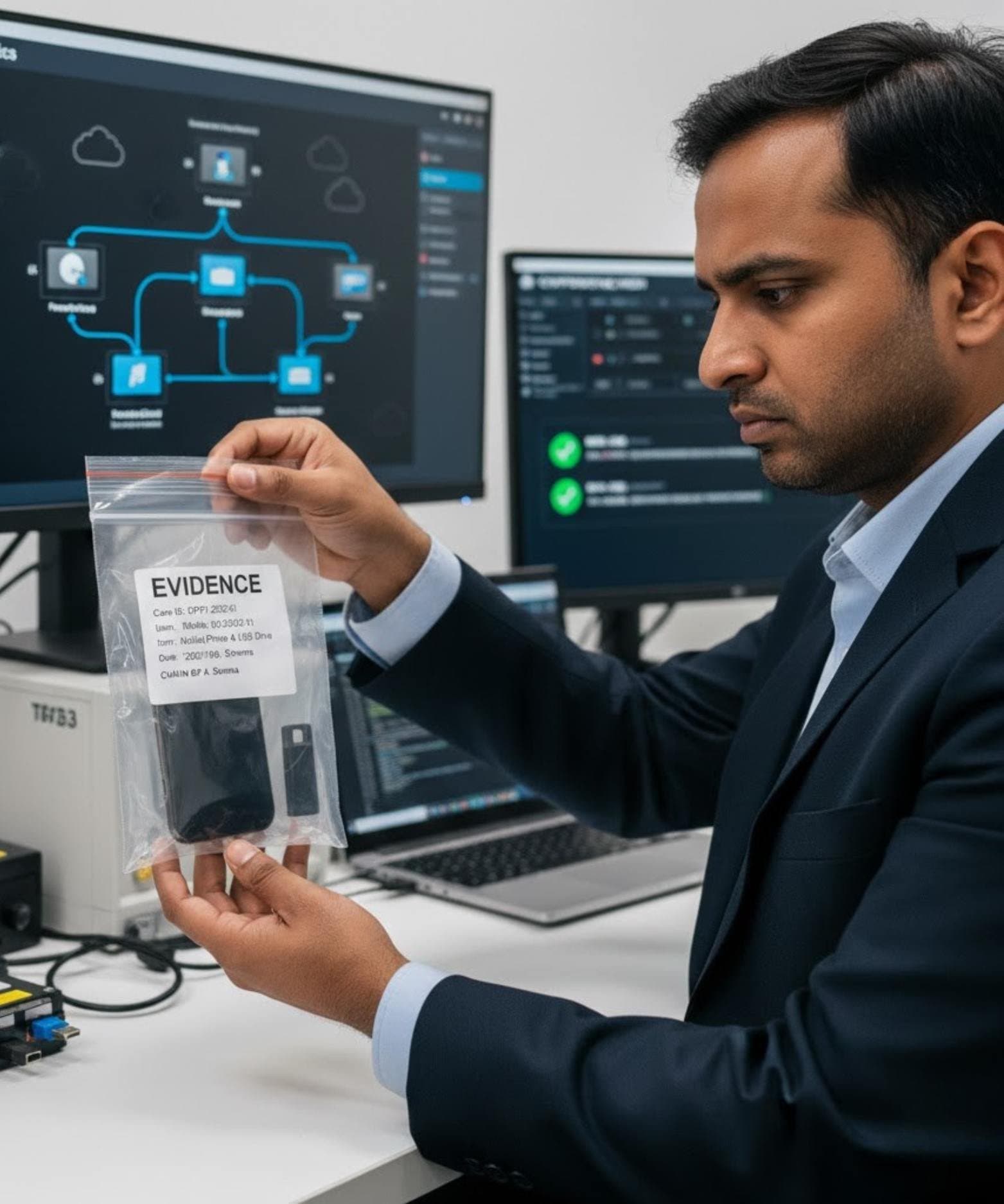
How It Touches Forensic Work and a Laboratory
The Schedule turns good laboratory practice into a legal form. Every item it asks for, the device identifiers, the hash of the record and the algorithm, is something a competent acquisition already records. The laboratory's job is to make sure those values exist for every exhibit at the moment of acquisition, that they are the values of the specific record being tendered and not only of the whole image and that the hash report the Schedule asks to be enclosed can be produced on demand. A certificate with a hash that nobody can reproduce is worse than none.
Section 63(4) asks for the certificate at each instance where the record is submitted, and it names both the person in charge and an expert. That means the examiner should expect to sign Part B personally, with a designation, and to be asked how the hash was computed, with what tool and whether it was verified. It also means the expert's part is about the record as produced, so a separate derivative, such as an exported folder or a transcript, needs its own identification and hash.
Explanation 5 to section 57 makes a record produced from proper custody primary evidence unless disputed. Proper custody is the chain of custody. A continuous record from seizure under the Bharatiya Nagarik Suraksha Sanhita, 2023, through acquisition, storage and every transfer, is what lets a laboratory say the image it examined is the record seized.
- Compute and record SHA-256, and any second algorithm the court is used to, for every record tendered
- Keep the hash report that the Schedule asks to be enclosed with the certificate
- Name the record precisely in Part B: device, identifiers and the file or image it refers to
- Treat each derivative as a separate record with its own hash and certificate
- Preserve the custody record; Explanation 5 to section 57 rests on proper custody
What the Adhiniyam Does Not Do, and Common Misunderstandings
- It does not decide what method an examiner should use or whether a tool is reliable. The certificate records a hash; it does not vouch for the analysis.
- A hash value in the Schedule proves that the record tendered matches the record hashed. It does not prove when the data was created, who created it or that it is true. Integrity and authenticity are different questions.
- The Schedule's lines for SHA1 and MD5 do not make those algorithms the standard. SHA-256 is the usual choice in forensic tools and the Schedule allows any legally acceptable standard. Record the algorithm you actually used.
- Section 63 does not require a notified Examiner of Electronic Evidence under section 79A of the Information Technology Act, 2000 to sign Part B. It requires an expert, and expertise is judged under section 39.
- The Adhiniyam does not govern how devices are seized or searched. That is the Bharatiya Nagarik Suraksha Sanhita, 2023.
Common Questions
Is a certificate needed every time an electronic record is produced?
Section 63(4) says the certificate shall be submitted along with the electronic record at each instance where it is being submitted for admission. Plan on one certificate per record per submission, and keep the hash report ready to go with it.
Who signs Part B if the laboratory is a government examiner notified under section 79A?
The Schedule asks for the expert's name, designation and signature. A notified laboratory's examiner signs as the expert in the ordinary way; the section 79A notification describes the laboratory's scope, it does not replace the certificate.
Is a forensic image primary evidence?
Explanation 5 to section 57 treats an electronic or digital record produced from proper custody as primary evidence unless disputed, and Explanation 4 treats each file of a record stored in multiple files as primary evidence. How a court applies these to a particular image will depend on its custody record and on whether the other side disputes it.
What if the hash on the certificate does not match the record in court?
Then the record tendered is not the record certified, or the certificate is wrong. Either way the laboratory should be able to show its acquisition log, the verification run and the custody record, and explain any known cause such as unreadable sectors. Hiding a mismatch is never an option.
Official sources
- Bharatiya Sakshya Adhiniyam, 2023 (47 of 2023), Gazette of India of 25 December 2023, with the Schedule certificateeGazette, Government of India
- Notification S.O. 2790(E) of 16 July 2024 on reading references to the Indian Evidence Act, 1872 as references to the AdhiniyameGazette, Ministry of Law and Justice
This page is educational material, not legal advice. Laws and standards change, commence on different dates and are interpreted differently across jurisdictions. Always read the official text linked on this page and take advice from a qualified professional for a real matter.
Disciplines where this applies
Courses that teach it
LegalFoundation & Legal CoursesLegal & Court ProceduresIndian law on electronic evidence: BSA Section 63, BNSS search and seizure and the IT Act. LegalFoundation & Legal CoursesForensic Report WritingWrite clear forensic reports that answer the questions asked and survive cross-examination.
 LegalFoundation & Legal CoursesBasics of Cyber ForensicsStart here. Evidence handling, imaging, hashing, chain of custody and your first analysis.
Go deeper with DFRTI
Free pages explain the ground. Structured courses, lab work and a mentor take you from knowing about it to doing it on a case.