 AdvancedAdvanced & Specialised ForensicsAI / Machine Learning ForensicsUse machine learning to sort large evidence sets and investigate AI systems
AI-Assisted Digital Investigations
AI-assisted investigation uses machine learning to sort, label, transcribe and summarise evidence faster than a person can, while leaving every finding to be checked by a human examiner.
Emerging and specialised6 evidence types8 tools4 coursesReviewed 2 November 2026
What it is and why it matters
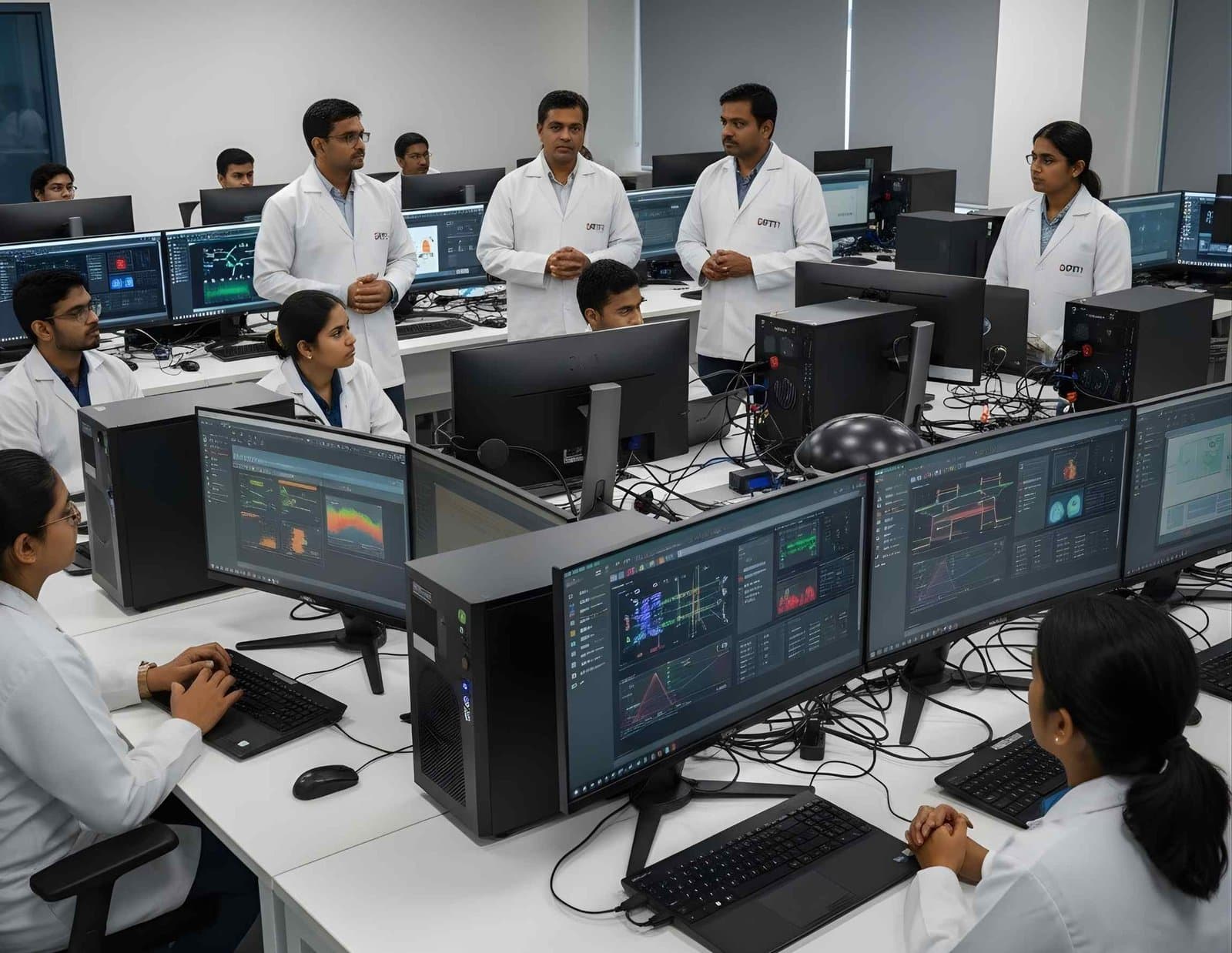
A single phone extraction can hold more photos, messages and files than one examiner can look at in a month, and a case may have ten phones. Machine learning is the practical answer to that volume. A classifier can sort a hundred thousand images into likely weapons, documents, screenshots, faces and nothing of interest in an hour. A speech model can turn days of call recordings into searchable text. A translation model can make a chat in one Indian language readable to an officer who speaks another. None of this finds the answer. It decides what a person should look at first.
The tools in use are more ordinary than the headlines suggest. Image and video classifiers, object and scene detection, optical character recognition, face grouping within a case, speech-to-text, machine translation, entity extraction from chats and, more recently, large language model assistants built into forensic suites that summarise conversations or answer questions about an extraction. Each is useful and each makes mistakes of a kind that a human reviewer must expect and catch.
The limits are the point. A model gives a probability, not a finding. It was trained on someone else's data and may do worse on Indian scripts, accents and image styles. A language model can state things that are not in the evidence at all. Bias in training data becomes bias in results. Sending evidence to a cloud service raises custody and data protection questions. In court the examiner, not the model, must explain how the conclusion was reached. Used with those limits in view, AI is a good assistant. Used without them, it is a liability.
Types of digital evidence
- Images and Video
Large media sets where classification, object detection, scene labelling and similarity grouping narrow the review and face grouping links images within one case.
- Audio
Call recordings, voice notes and interviews, where speech-to-text makes content searchable and speaker separation helps attribute turns, always with the audio kept as the record.
- Chats and Documents
Message databases and document sets where entity extraction pulls out names, numbers, amounts and places and summarisation gives a first map of a long conversation.
- Multilingual Content
Material in several Indian languages and in transliterated scripts, where machine translation gives an officer a working reading before a human translator confirms it.
- Logs and Timelines
Millions of events from systems and networks, where anomaly detection and clustering point to the hours that deserve a close look.
- Known Material
Hash matching against databases of known files, which is exact and not probabilistic, sitting alongside classifiers that flag unknown but similar material.
Devices and data sources
- Mobile device extractions with their media, chats and app data
- Computer and server images with documents, email and logs
- CCTV and body-worn camera footage
- Call recordings, voice notes and interview audio
- E-discovery document sets in corporate matters
- Network and system logs from incident response
- Open-source material gathered in OSINT work
How an examination runs
The order matters. Each step protects the one after it.
- 01State the Question
Decide what the AI step is for and what it is not for, for example finding every image of a document. A tool run without a question produces output no one can defend.
- 02Choose a Validated Model
Use a model or feature the laboratory has tested on known material similar to the case, with its error rates recorded. If it has not been tested, test it first or do not rely on it.
- 03Run on a Copy
Process a working copy and keep the model's output separate from the evidence. Note whether the processing happened on the laboratory's own hardware or at a cloud service, and under what agreement.
- 04Review Every Hit Relied Upon
A person looks at each item that will appear in a finding. Items the model missed are a known gap and the report says so.
- 05Record the Settings
Model name, version, thresholds, prompts and the date of the run, so another examiner can repeat it and get the same result.
- 06Check With Known Samples
Seed the data with items of known type or re-run on a validation set to see how the model behaved on this case's material.
- 07Report What the AI Did
Say which steps used a model, what it produced, how it was checked and what it could not do. The conclusions are the examiner's.
Tools used in this discipline
Independent profiles: what each tool does, where it stops and what you need to know before using it.
- Mobile forensicsCurrentCellebrite PathfinderCellebrite
Pathfinder is Cellebrite's analytics layer. It takes the output of many extractions and other data sources and lets a case team search, link and visualise them together, on a server the agency controls or in a cloud environment.
- Mobile forensicsTransitioningCellebrite Physical AnalyzerCellebrite
Physical Analyzer is the decoding and analysis side of Cellebrite's mobile workflow. PA 7 is being discontinued and the database-backed PA Ultra has become Inseyets.PA 10.x.
- Computer forensicsCurrentMagnet AxiomMagnet Forensics
Axiom is Magnet Forensics' main examination platform. It takes images and extractions from computers, phones, cloud accounts and vehicles into a single case and presents the artefacts side by side.
- Mobile forensicsUnverifiedOxygen Forensic DetectiveOxygen Forensics
Oxygen Forensic Detective is an all-in-one extraction and analysis tool for phones, cloud accounts, drones and other connected devices. On 2 November 2026 the maker's website could not be checked, so this profile is marked unverified.
- Network and enterpriseCurrentPlasolog2timeline project
Plaso pulls every timestamp it can recognise out of a disk image or folder and writes them to one storage file. Sorted, that file is the super timeline investigators use to see what happened in what order.
- Network and enterpriseCurrentTimesketchGoogle (open source project)
Timesketch is a web application where several analysts work on the same timeline. Events from Plaso or CSV go into a sketch and the team searches, tags, comments and builds its account of events from them.
- Multimedia and videoCurrentAmped AuthenticateAmped Software
Amped Authenticate asks a different question from FIVE. Not what does this picture show, but can this file be trusted. It tests integrity, reconstructs processing history, links an image to a camera and searches for manipulated or generated content.
- Multimedia and videoCurrentForensicallyJonas Wagner
Forensically is a free web page of image analysis tools that run inside the browser, so the picture never leaves the examiner's computer. It is a teaching and first-look tool, and its author says plainly that it cannot tell true from false.
Terminology
- Machine Learning
- Software that learns patterns from examples rather than following rules written by a programmer. Its behaviour depends on the examples it saw.
- Classifier
- A model that assigns a label, such as weapon or document, to an input with a confidence score. The score is not a probability of truth in any legal sense.
- Confidence Threshold
- The score above which a tool reports a hit. Lower it and more is found with more false alarms. Raise it and more is missed. The choice must be recorded.
- False Positive and False Negative
- A hit that is wrong and a miss that should have been a hit. Every model produces both, and a laboratory should know its rates on material like the case's.
- Hallucination
- A language model producing fluent text that is not supported by its input, such as a summary that includes a message no one sent.
- Large Language Model
- A model trained on vast text that can summarise, translate and answer questions. Useful for a first reading, unreliable as a source of fact about the evidence.
- Explainability
- The ability to say why a model produced a result. Many models cannot, which is a problem when a court asks the question.
- Validation
- Testing a tool or model on known material to measure how it performs before it is used on evidence, and documenting the result.
- Hash Matching
- Comparing a file's fingerprint with a list of known files. Exact and repeatable, and not machine learning, though often found in the same tools.
- Bias
- Systematic error from training data that does not represent the material in hand, such as a face grouper tuned on faces from elsewhere.
Challenges and limits
What makes it hard
- Models trained abroad perform differently on Indian languages, scripts, accents and image styles, and the gap is rarely measured
- Language model assistants can invent content, so any summary or answer must be traced back to the actual records before use
- Confidence scores invite over-trust, and a score of ninety per cent still means one wrong result in ten
- Sending evidence to a cloud model moves it outside the laboratory's control and may breach data protection and custody rules
- Vendors update models silently, so a result obtained last year may not be reproducible today without a recorded version
- Explaining a neural network's decision to a court is often not possible, which limits what the output can support
- Welfare of examiners who review flagged material remains a human problem that triage reduces but does not remove
Keeping the evidence intact
- Keep model output as a separate work product with its own hash, never written into the evidence set
- Record the model, version, thresholds and prompts for every run and keep them with the case file
- Process on laboratory systems where possible, and where a cloud service is used, document the provider, the agreement and what data left the laboratory
- Have a human examiner verify every item that supports a finding and state in the report that this was done
- Validate each model on known material before first use and again after any update
Standards and legal considerations
- NIST AI Risk Management Framework
NIST AI 100-1 of January 2023, a voluntary framework for governing, mapping, measuring and managing AI risk, with a 2024 profile for generative AI. A useful structure for a laboratory deciding how to adopt AI features.
- SWGDE Overview of Artificial Intelligence Trends in Video Analysis
SWGDE's 2021 overview of how machine learning is applied to video evidence, alongside its position that facial comparison tools support examination rather than replace it.
Read the guide - ISO/IEC 27042:2015
Guidelines for the analysis and interpretation of digital evidence. Its demands for repeatable, documented and justified analysis apply to any step a model performs.
Read the guide - Digital Personal Data Protection Act, 2023
Evidence sent to an AI service is personal data being processed by a third party. The Act frames what that requires and when investigative exceptions apply.
Read the guide - India AI Governance Guidelines
Released by the Ministry of Electronics and Information Technology in November 2025, a voluntary framework favouring sector-specific oversight and accountability for AI deployments, which laboratories can expect regulators and courts to refer to.
In practice
- Finding the Ledger Photos
A fraud case has six phones with over two lakh images. An image classifier tuned for documents and handwriting flags a few thousand candidates. The examiner reviews them, finds photographed ledger pages on two phones and reports the classifier settings and the fact that pages it missed cannot be ruled out.
- A Summary That Was Wrong
A language model assistant summarises a year of chat between two suspects and states that a payment was agreed on a certain date. The examiner searches the database, finds no such message and reports the summary as a tool output that failed verification, with the raw messages instead.
- Transcripts in Three Languages
Call recordings mix Hindi, Marathi and English. Speech-to-text gives searchable drafts in hours. Each passage used in the report is checked against the audio by a human and the drafts are labelled as machine-generated in the case file.
This page is educational material, not legal advice. Laws and standards change, commence on different dates and are interpreted differently across jurisdictions. Always read the official text linked on this page and take advice from a qualified professional for a real matter.
Learn it at DFRTI
Free pages explain. These courses teach it on real devices with a mentor.
AdvancedAdvanced & Specialised ForensicsAI / Machine Learning ForensicsUse machine learning to sort large evidence sets and investigate AI systems VideoSurveillance & Image / Video ForensicsDeepfake / AI ForensicsExamine face swaps and AI-made media, check C2PA provenance and know where detectors fail
 LegalFoundation & Legal CoursesForensic Report WritingWrite clear forensic reports that answer the questions asked and survive cross-examination.
 LegalFoundation & Legal CoursesLegal & Court ProceduresIndian law on electronic evidence: BSA Section 63, BNSS search and seizure and the IT Act.
Careers that use it
Questions people ask
Can AI examine a device by itself?
No. It can sort, flag, transcribe and summarise so that a person looks at the right things first. Every item that supports a finding is checked by a human examiner, and the report says what the AI did and what was verified.
Will a court accept a result from a machine learning tool?
What a court accepts is the examiner's evidence, which must be explainable and repeatable. A model's output supports that evidence only when the examiner can describe the tool, its validation and the checks made. An unexplained score on its own is weak.
Is it safe to put evidence into a public AI chatbot?
Evidence should not leave the laboratory's control without authority and an agreement that covers storage, use and deletion. Many services keep what they receive. Laboratories prefer models that run on their own systems or vendor features with documented data handling.
Does AI make face recognition reliable?
Within a case, grouping similar faces helps link images. Identifying a person from a face is a separate claim that depends on image quality, the comparison method and the population, and it is treated as an investigative lead rather than a finding.
How often do these tools get it wrong?
It depends on the model, the material and the threshold, which is why laboratories measure error rates on known samples before use. A tool that has not been tested on material like the case's has an unknown error rate, and the report must say so.
Further reading
More in Emerging and specialised
Go deeper with DFRTI
Free pages explain the ground. Structured courses, lab work and a mentor take you from knowing about it to doing it on a case.